
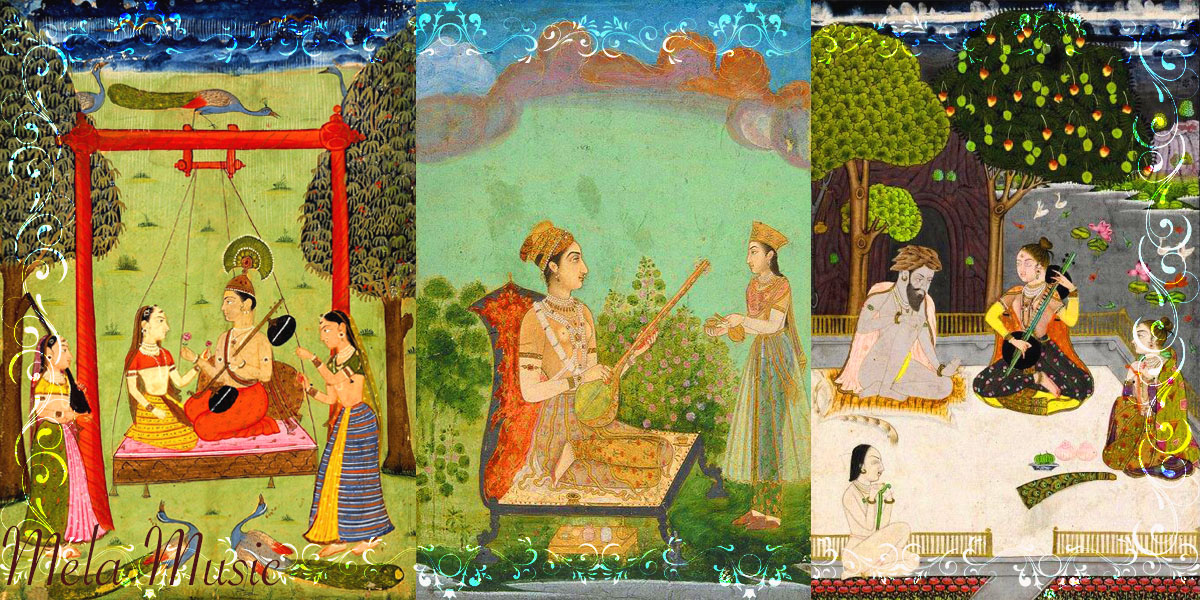
Excerpts from some of our terms which are available once you join!
TERM – RAGA
The term ‘Raga’ has an etymological root in the word ‘color’. In the context of music, a raga is a harmonious combination of swar (notes) and varna (different uses of notes). The notes of a raga are arranged in a particular fixed, ascending, descending, or oscillating pattern, which imbues the composition with an emotional quality. While a raga is essentially a melodic concept, it should not be confused with a song, as a single raga can serve as the foundation for countless songs. Technically speaking, a raga is a musical entity with a specific number and sequence of notes, categorized by a particular thaat, murchhana, and ascending and descending movements, as well as their relative duration and intonation. To be considered a true raga, a composition must possess virtues such as vadi, samvadi, graha swar, nyaas swar, and varna-alamkara.
The characteristics of a raga follow:
- Most ragas come from an existing thaat, although there are many that cannot be grouped into a thaat.
- A minimum of 5 notes and a maximum of 7 notes are used to form raga. The number of notes used denotest the jaati of a raga.
- The note SA is never omitted and PA and MA are never omitted at the same time.
- Every raga will have a vadi and samvadi.
- Each raga will have an aroha and avaroha.
- Each raga has a principal mood defined.
- Each raga is associated with a time (prahar) or season.
Learn about 50+ Ragas, clearly defined!
Raga Bageshree is a prominent and popular raga in Indian classical music. It belongs to the Kafi thaat and is traditionally performed during the late evening hours, typically associated with the romantic and expressive aspects of music.
Bageshree is characterized by its distinctive melodic phrases and intricate ornamentations. The mood of Raga Bageshree is often described as contemplative, introspective, and romantic. It evokes a range of emotions, including longing, yearning, and deep emotional intensity. The expressive power of this raga lies in its ability to evoke a sense of longing and evoke a poignant atmosphere.
Musicians explore the melodic framework of Bageshree through various improvisational techniques. The alap, a slow and meditative exposition of the raga, allows the artist to delve into the intricate melodic patterns, gradually unfolding the essence of the raga. This section emphasizes the exploration of microtones, meends (glides), and gamakas (grace notes), which lend Bageshree its characteristic flavor.
Bageshree’s melodic structure allows for a wide range of expressions and improvisations. Its versatility has led to its incorporation in various musical genres, including semi-classical forms such as thumri, dadra, and ghazal. It has also found its place in film music, where its emotional depth and melodic appeal have made it a favorite among composers and listeners.
Raga Bageshree holds a special place in the hearts of musicians and connoisseurs of Indian classical music. Its evocative and introspective nature, combined with its melodic beauty, make it a raga that resonates deeply with both performers and audiences, creating a captivating and emotionally rich musical experience.
Prahar – 6 (9pm – 12am)
Thaat – Kafi
Aroha –
Avaroha –
Pakad –
Vadi Swar – MA
Samvadi Swar – SA
Content provided by Sangeetpedia